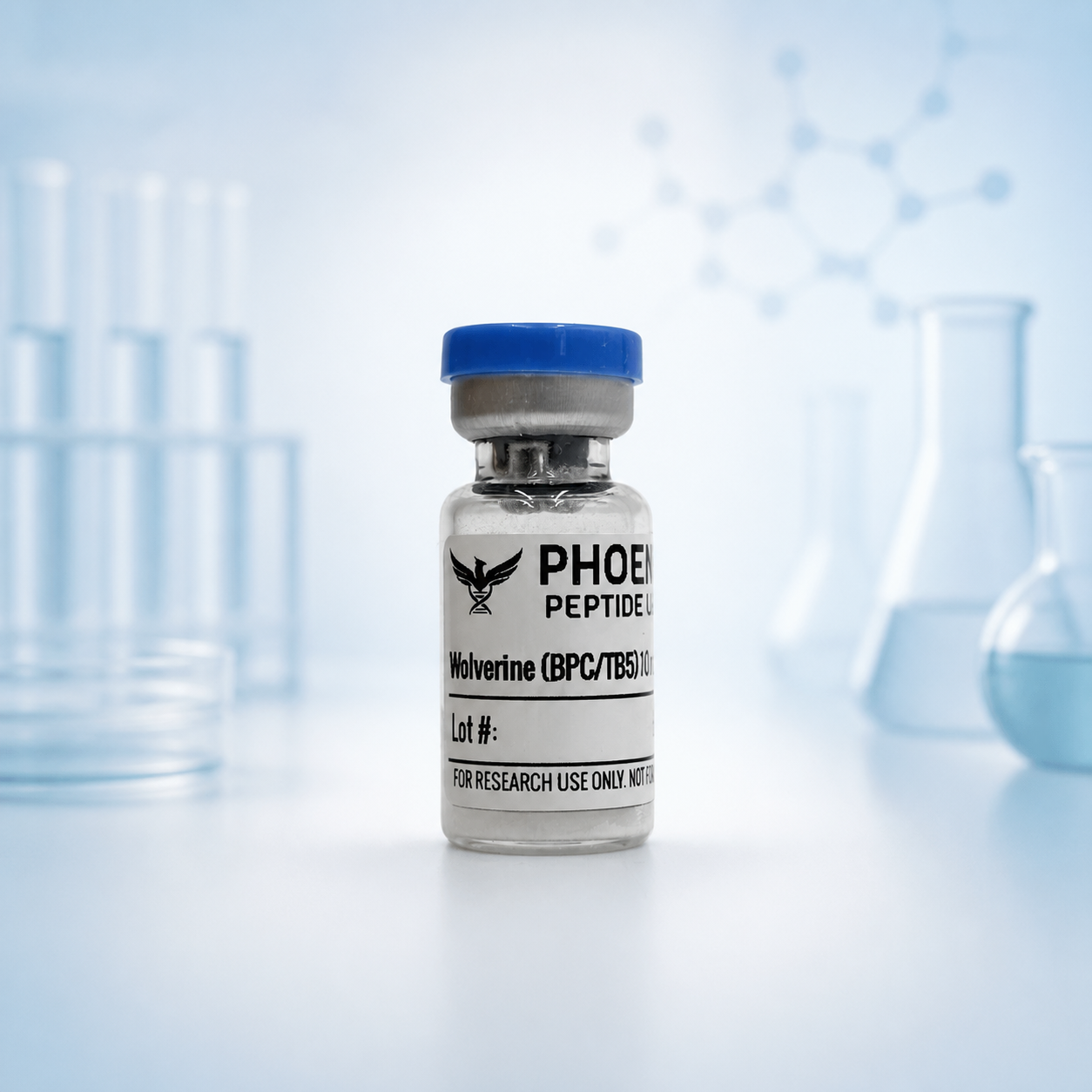
Wolverine Peptide I: BPC-157 / TB-500 (10mg / 10mg)

The Wolverine Peptide I blend combines BPC-157 and TB-500 in equal doses to support tissue repair and recovery through complementary mechanisms. BPC-157 focuses on localized healing by promoting angiogenesis and structural repair, while TB-500 enhances systemic cell migration and regeneration. Together, they create a synergistic effect that supports faster recovery from injuries and improved tissue repair. Despite growing interest, neither compound is FDA-approved and both are restricted, including being banned by WADA.

$56.95

- +
SKU N/A Category
Metabolic & Energy Research
Growth Hormone & Muscle
Tissue Repair & Healing
Anti-Aging & Longevity
Cognitive & Neurological
Sexual Health Research
Pigmentation & Dermatology

Description

The mechanistic rationale for this combination is among the most clearly articulated in peptide research — two distinct molecular mechanisms that operate in spatial and temporal parallel across all phases of soft tissue healing.

BPC-157 — Local Vascular Architecture and Structural Repair

BPC-157’s mechanism is comprehensively detailed in its dedicated product page. Within the specific context of this binary blend, its irreplaceable contributions are:

VEGFR2/Akt-eNOS Angiogenesis

  • BPC-157 activates VEGF Receptor 2 (VEGFR2) on endothelial cells at and near the injury site → Akt phosphorylation → eNOS activation → nitric oxide production → vasodilation and de novo capillary sprouting​
  • This creates a vascularized tissue bed at the injury site — the essential prerequisite for all downstream cellular repair. Without new capillary networks, oxygen and nutrient delivery to the wound zone is insufficient to sustain the high metabolic demands of proliferating fibroblasts and synthesizing collagen
  • BPC-157’s angiogenesis is injury-localized: it activates collateral vessel formation around occluded or damaged vessels, restoring perfusion to previously ischemic tissue — a property uniquely important for tendons, ligaments, and cartilage, which have naturally poor baseline vascularization

FAK-Paxillin Fibroblast Activation

  • BPC-157 activates focal adhesion kinase (FAK) and paxillin in tendon fibroblasts — the signaling complex that anchors cells to the extracellular matrix and initiates the cellular motility machinery​
  • In Chang et al.’s seminal tendon outgrowth study, BPC-157 increased fibroblast migration speed up to 2.3-fold — a direct structural-level healing acceleration at the wound interface​

Mesenchymal Stem Cell and Periosteal Cell Recruitment

  • BPC-157 uniquely activates periosteal cells and recruits mesenchymal stem cells to damaged connective tissue interfaces, enabling the muscle-to-bone and tendon-to-bone reattachment that neither TB-500 nor any other peptide in this catalog specifically addresses​

Nitric Oxide System Modulation

  • BPC-157 maintains physiological balance in the nitric oxide system — stabilizing vascular tone, preventing ischemic vasoconstriction, and sustaining the vasodilatory environment necessary for robust nutrient delivery throughout the healing period

TB-500 — Systemic Cellular Mobilization and Anti-Fibrotic Remodeling

TB-500’s mechanism is comprehensively detailed in its dedicated section of the GHK-Cu/TB-500/BPC-157 product page. In this binary combination context, its unique contributions are:

G-Actin Sequestration — The Cellular Traffic Director

  • TB-500 binds free G-actin (monomeric actin) in cells throughout the body — not just at the injury site — buffering the G-actin/F-actin equilibrium and thereby controlling the cytoskeletal dynamics that determine whether cells can change shape, migrate, divide, and adhere to new locations
  • By maintaining a mobile, reorganizable cytoskeleton in repair cells, TB-500 enables the rapid, directional migration of fibroblasts, keratinocytes, satellite cells, and endothelial cells toward injury-generated chemotactic gradients
  • This is TB-500’s systemic advantage over BPC-157’s more localized action: TB-500 circulates throughout the body and primes every potential repair cell for migration readiness — not just those near the injection or injury site

Endothelial Cell Migration — Complementary Angiogenesis Pathway

  • While BPC-157 drives angiogenesis through VEGFR2 signaling on resident endothelial cells, TB-500 drives angiogenesis through a cell-trafficking mechanism — mobilizing circulating endothelial progenitors and promoting directed endothelial migration into the wound bed
  • These are two independent and additive angiogenic pathways — BPC-157 provides the molecular signal; TB-500 provides the cellular workforce for vascular tube formation

Anti-Fibrotic Remodeling

  • TB-500 reduces myofibroblast numbers at wound sites — myofibroblasts are the cells responsible for scar tissue contraction and fibrosis​
  • This anti-fibrotic activity guides matrix deposition toward organized, functional collagen rather than disorganized scar, preventing the strength-compromising tissue architecture that often limits return-to-function after musculoskeletal injury
  • Critically, BPC-157 independently modulates MMP/TIMP balance for collagen turnover — the two peptides address the anti-fibrotic outcome through complementary matrix remodeling mechanisms​

ILK-Akt Cell Survival

  • TB-500 activates Integrin-Linked Kinase (ILK) → Akt signaling in cardiomyocytes and other cell types, reducing apoptosis in the ischemic wound environment​
  • This anti-apoptotic signaling protects repair cells that have migrated to the oxygen-depleted wound zone from dying before completing their repair function — a form of cellular persistence that is complementary to BPC-157’s oxygen delivery (through angiogenesis) at the same site

The Core Synergy — Local + Systemic, Structural + Cellular

The combination’s pharmacological logic rests on a fundamental division of labor:

Dimension

BPC-157

TB-500

Combined

Primary mechanism

VEGFR2/eNOS angiogenesis; FAK-paxillin; structural repair

G-actin sequestration; cell migration; ILK-Akt

Vascular architecture + cellular workforce

Spatial range of action

Primarily local / injury-site concentrated

Systemic — acts throughout the body

Local structural + systemic cellular coverage

Angiogenesis pathway

VEGFR2 molecular signaling

Endothelial cell migration

Two independent, additive pro-angiogenic inputs

Anti-fibrosis

MMP/TIMP collagen turnover regulation

Myofibroblast reduction

Dual anti-fibrotic mechanism

Receptor target

VEGFR2, GHR, nitric oxide system

G-actin, ILK, integrins

Non-competing, no receptor overlap

Cell types directly activated

Tendon fibroblasts, periosteal cells, MSCs

Fibroblasts, keratinocytes, endothelial cells, satellite cells

Comprehensive cell type coverage

Structural specialty

Tendon-to-bone, muscle-to-bone reattachment

Organized collagen architecture; anti-scar

Full tissue architecture restoration

A useful clinical analogy: BPC-157 builds the highway; TB-500 puts the cars on it. BPC-157 establishes new blood vessel networks and activates structural repair pathways; TB-500 ensures that a continuous flow of migratory repair cells — the workers that carry out the actual rebuilding — arrives at the construction site and operates efficiently.

TB-500 Metabolite Nuance

A 2024 study noted that TB-500 (Ac-LKKTETQ) itself may not directly increase wound-healing activity in isolation — rather, its metabolite Ac-LKKTE was identified as the active wound-healing agent, suggesting TB-500 acts as a prodrug-like precursor that is metabolized in vivo to its active form. This does not diminish its pharmacological value but is an important mechanistic nuance acknowledged in the current literature.​

Research Evidence

BPC-157 Research Evidence in the Context of This Combination

The BPC-157 evidence is comprehensively detailed in the dedicated BPC-157 product page. Key data directly relevant to the Wolverine Peptide I indications (musculoskeletal injury, soft tissue repair):

  • Tendon healing: Chang et al. (2011, Journal of Applied Physiology) — BPC-157 increased tendon fibroblast migration up to 2.3-fold, improved Achilles tendon healing biomechanics, and activated FAK-paxillin signaling​
  • Systematic review (2025, AJSM): 36 studies in orthopedic applications confirmed consistent improvements in tendon repair, muscle healing, and bone healing across preclinical models​
  • Muscle repair: Three animal transection and crush models showing BPC-157-treated subjects had improved motor function, load to failure, and reduced atrophy​

TB-500 / Thymosin Beta-4 Research Evidence

  • Dermal wound healing Phase 2 trials: Tβ4 promoted wound healing in patients with pressure ulcers, stasis ulcers, and epidermolysis bullosa — patients benefited from TB4 therapy with a well-tolerated and safe profile​
  • Diabetic wound model (2003): TB4 (including its LKKTETQ fragment) accelerated wound healing in healthy, diabetic, and aged mice — critically, the synthetic TB-500 fragment alone promoted repair in aged animals “comparable to that observed with the parent molecule”​
  • Cardiac repair (RegeneRx Phase 2 AMI trial, 2024): Tβ4 evaluated in 90 STEMI patients — completed Phase 2 with well-tolerated safety profile​
  • TBI neuroprotection: Tβ4 reduced neurological deficit scores, decreased contusion volume, and promoted neurogenesis in rats following experimental TBI — adding a CNS-protective dimension to the combination’s profile​
  • Anti-scarring: TB4 consistently reduced myofibroblast density in wound models, supporting less fibrotic, more functional healing​
  • 2024 metabolite study: Identified that Ac-LKKTE (TB-500 metabolite) rather than parent TB-500 may carry the wound-healing activity — important mechanistic nuance that does not negate the combination’s biological value​

The Combination — Direct Evidence

No published peer-reviewed randomized controlled trial has specifically evaluated the BPC-157 + TB-500 combination in humans. The combination’s evidence base rests on:

  1. Individual preclinical evidence for each compound (primarily animal models)
  2. Non-overlapping, complementary mechanisms that make pharmacological interference between the compounds essentially impossible
  3. Limited human Tβ4 Phase 2 trial data (dermal wounds, cardiac repair) confirming TB-500’s parent molecule’s safety in humans
  4. Absence of published adverse events from the combination in any preclinical or clinical report
  5. The 2025 Ukrainian sports medicine systematic review explicitly characterized the combination as representative of the “grey zone” pharmacology literature — acknowledging its biological plausibility while noting the fundamental clinical evidence gap​

A 2025 Yahoo Finance report noted that searches for the “Wolverine peptide stack” surged significantly ahead of 2026, reflecting the combination’s growing cultural penetration in sports and fitness communities despite the limited clinical evidence base.​

Current Status

WADA Status

Both compounds are explicitly prohibited by name on the WADA 2026 Prohibited List — making this the most sport-prohibited product in this catalog:

  • BPC-157: Section S0 (Non-Approved Substances) — banned at all times, in- and out-of-competition
  • TB-500 (Thymosin Beta-4 and its fragments): Section S2.2.5 (Growth Factors) — “Thymosin β4 and its mimetics and fragments (e.g. TB-500)” — explicitly named — banned at all times

The 2025 Ukrainian systematic review (Pharmacological and Clinical Sciences) specifically characterized BPC-157 and TB-500 as the “most popular substances in the grey zone market” for sports injury recovery, noting their widespread anecdotal use in direct contrast to their official S0/S2 prohibited status. Athletes in any sport governed by WADA, NCAA, or U.S. professional leagues (which adopt WADA standards) should be unambiguously informed that use of either component in this blend constitutes a doping violation with potential multi-year competition bans.​

FDA Status

Both compounds appear on the FDA’s Section 503A Category 2 bulk drug substance list:

  • BPC-157: Category 2 — immunogenicity, impurity, and insufficient safety information concerns
  • TB-500 (Thymosin Beta-4): Category 2 — same rationale
  • Both are subject to the ongoing PCAC review process following the September 2024 Evexias/Farmakeio legal settlement​
  • Both are sold commercially as research chemicals labeled “not for human use”; this is the legal status under which this product is offered

“Healthy Male” Medical Advisory (2026)

A February 2026 advisory by Australia’s Healthy Male (Andrology Australia) specifically discussed the Wolverine Stack, noting concerns about widespread use outside clinical oversight and the disconnect between the anecdotal enthusiasm for the combination and the absence of human clinical trial evidence — a reflection of the combination’s profile reaching mainstream medical attention.​

Safety Profile

BPC-157 Safety

Comprehensively detailed in the dedicated BPC-157 product page. Summary: no identified lethal dose across multiple species and routes at doses from 6 μg/kg to 20 mg/kg; no organ toxicity, mutagenicity, teratogenicity, or genotoxicity in preclinical GLP-grade safety studies; a 2025 pilot human IV study (2 subjects, up to 20 mg) showed no adverse effects. Theoretical cancer/angiogenesis concern unresolved; long-term safety data absent.

TB-500 Safety

  • Phase 1 IV safety study: Well tolerated at clinical doses with no serious adverse events​
  • Dermal Phase 2 trials: Safe and well tolerated in wound healing applications​
  • Phase 2 cardiac trial: 90 STEMI patients — no dose-limiting toxicities reported​
  • No published organ toxicity, mutagenicity, or teratogenicity concerns​
  • Manufacturing quality remains the dominant safety variable for compounded/research preparations​

Combination-Level Safety

  • No pharmacokinetic or pharmacodynamic interactions are expected — the two compounds act on entirely different receptor systems with no known cross-talk that could produce adverse effects
  • The most consistently reported adverse effects are injection site reactions (redness, transient pain, swelling) for both compounds
  • The absence of published adverse events from the combination in either controlled studies or widespread anecdotal use over several years of community reporting is notable, though absence of evidence is not evidence of absence​
  • Water retention: GH-axis effects are not a feature of this combination (unlike the GH secretagogue blends); water retention is not expected
  • Long-term safety: No study has characterized adverse events beyond 8–12 weeks for either compound, alone or in combination
  • Cancer risk: BPC-157’s pro-angiogenic mechanism carries the same theoretical tumor-promotion concern noted in the BPC-157 product page; TB-500’s endothelial cell mobilization activity is theoretically subject to the same concern

References

BPC-157 (full reference list in dedicated BPC-157 page)

  1. Chang, C.H., et al. (2011). The promoting effect of pentadecapeptide BPC 157 on tendon healing. Journal of Applied Physiology, 110(3), 774–780.
  2. Rodella, L.F., et al. (2025). Emerging Use of BPC-157 in Orthopaedic Sports Medicine: Systematic Review. American Journal of Sports Medicine (PMC12313605).
  3. Sikiric, P., et al. (2020). Stable Gastric Pentadecapeptide BPC 157, Robert’s Stomach Cytoprotection/Adaptive Cytoprotection, and Organoprotection. Gut and Liver, 14(2), 153–167.

TB-500 / Thymosin Beta-4
4. Smart, N., et al. (2010). Animal studies with thymosin β4, a multifunctional tissue repair and regeneration peptide. Annals of the New York Academy of Sciences, 1194, 133–144. 
5. Bock-Marquette, I., et al. (2021). Utilizing Developmentally Essential Secreted Peptides Such as Thymosin Beta-4. Frontiers in Bioengineering and Biotechnology, 9, 672399. 
6. Mahmoud, M., et al. (2012). Neuroprotective and neurorestorative effects of thymosin β4 following traumatic brain injury. Journal of Neurotrauma, 29(13), 2285–2292. 
7. Sosne, G., et al. (2023). Thymosin Beta 4: A potential novel adjunct treatment for bacterial keratitis. International Immunopharmacology, 118, 109953. 
8. Innerbody Research. (2026). TB4 and TB-500 Peptide Therapy — What to Know in 2026. 

Wolverine Combination
9. Melnyk, O., et al. (2025). BPC-157 and TB-500 in Sports Injury Recovery: A Grey Zone Systematic Review. Pharmacological and Clinical Sciences (Khmelnitsky Natl. University). 
10. Revolution Health & Wellness. (2025). BPC-157 + TB-500 Combination: Benefits, Differences, and When to Use. 
11. Drip Hydration. (2025). What is the Wolverine Stack? BPC-157 + TB-500. 
12. Healthy Male (Andrology Australia). (2026). What you need to know about the “Wolverine Stack.” 

Regulatory
13. World Anti-Doping Agency. 2026 Prohibited List, Sections S0 and S2.2.5. 
14. U.S. FDA. Substances in Compounding that May Present Significant Safety Risks (503A). 
15. Safe Harbor Group. (2026). FDA’s Overreach on Compounded Peptides. 

Reviews

There are no reviews yet.

Be the first to review “Wolverine Peptide I: BPC-157 / TB-500 (10mg / 10mg)”

Your email address will not be published. Required fields are marked *

Latest News

Latest Research Updates

Curated news and publications on peptides, metabolic research, and cellular energy modulation.