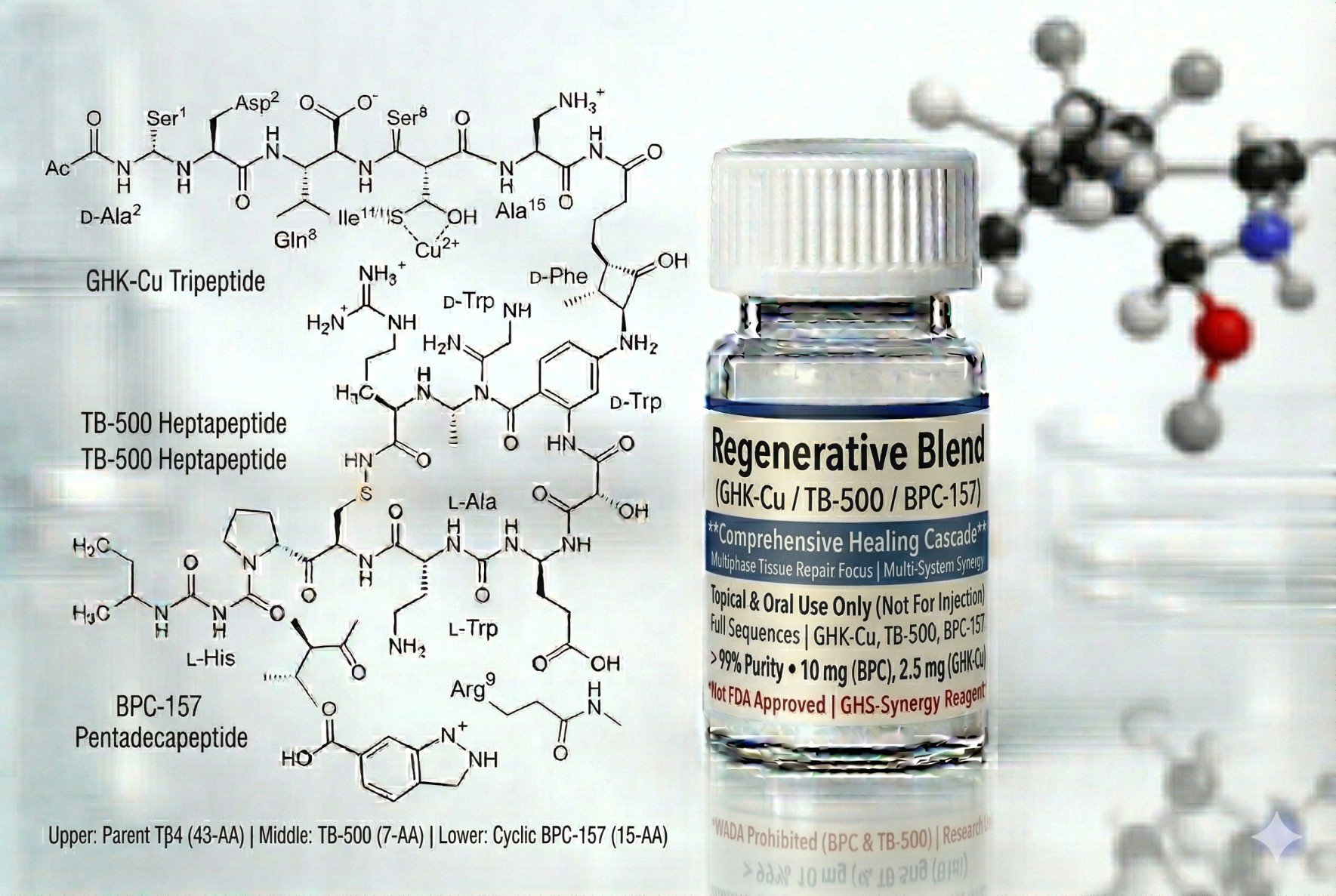
GHK-Cu / TB-500 / BPC-157 GLOW Blend (50mg / 10mg / 10mg)

The GHK-Cu / TB-500 / BPC-157 Regenerative Blend combines three complementary peptides designed to support the full spectrum of tissue repair and recovery. GHK-Cu promotes gene expression, anti-inflammatory activity, and skin/tissue regeneration; TB-500 enhances cell migration and wound healing; while BPC-157 supports angiogenesis and structural repair of muscles, tendons, and ligaments. Together, they provide a multi-phase approach to healing and recovery. Despite promising research, none are FDA-approved, and their use is restricted, with BPC-157 and TB-500 also banned by WADA.

$128.95

Out of stock

Category
Metabolic & Energy Research
Growth Hormone & Muscle
Tissue Repair & Healing
Anti-Aging & Longevity
Cognitive & Neurological
Sexual Health Research
Pigmentation & Dermatology

Description

Each peptide in this blend targets a distinct biological pathway, and the three pathways operate in a coordinated, temporally overlapping sequence that provides comprehensive coverage of the healing cascade.

GHK-Cu — Gene Expression Reset, ECM Remodeling, and Angiogenesis

GHK-Cu operates through three primary mechanisms: copper-mediated enzymatic activation, extracellular matrix (ECM) remodeling, and broad-spectrum gene expression modulation:

Copper Chaperone and Enzymatic Activation

  • GHK’s histidine residue chelates Cu²⁺ with high affinity, serving as a copper chaperone that delivers bioavailable copper to copper-dependent enzymes at the site of injury
  • Key copper-dependent enzymes activated include: lysyl oxidase (crosslinks collagen and elastin fibers for tensile strength), superoxide dismutase (Cu/Zn-SOD) (neutralizes superoxide radicals), and ceruloplasmin (ferroxidase involved in iron metabolism and antioxidant defense)
  • Copper delivery to cytochrome c oxidase (Complex IV) of the mitochondrial ETC also supports cellular bioenergetics in injured tissues

ECM Remodeling — Collagen, Elastin, and Proteoglycans

  • GHK-Cu is among the most potent known stimulators of fibroblast collagen synthesis: in vitro, it increases Type I and III collagen mRNA expression; in vivo rat wound chamber studies demonstrated a concentration-dependent increase in collagen content that was twice that of non-collagen protein stimulation
  • GHK-Cu uniquely stimulates both synthesis and breakdown of collagen simultaneously through balanced MMP (matrix metalloproteinase) and TIMP (tissue inhibitor of MMP) regulation — accelerating turnover and preventing excessive scar/fibrosis while building new organized matrix
  • Additional ECM targets: elastin, decorin (a small leucine-rich proteoglycan that organizes collagen fibrils), chondroitin sulfate, dermatan sulfate, and glycosaminoglycans (including hyaluronic acid) — a comprehensive remodeling profile

Angiogenesis and Nerve Outgrowth

  • GHK-Cu activates VEGF (Vascular Endothelial Growth Factor) and supports endothelial cell proliferation, migration, and tube formation — stimulating formation of new capillary networks essential for delivering oxygen and nutrients to healing tissue
  • Nerve growth factor (NGF)-like effects: GHK-Cu promotes neuronal outgrowth and may support peripheral nerve regeneration at injury sites​

Gene Expression Remodeling — The Genomic Dimension

  • The most expansive — and most scientifically striking — dimension of GHK-Cu biology comes from genomic profiling using the Broad Institute’s Connectivity Map (CMap): GHK was found to modulate expression of 4,047 human genes, with a pattern that globally shifts cells toward younger, less-diseased transcriptional states
  • Key gene categories upregulated: DNA repair genes (47 of 55 DNA repair genes tested), anti-cancer tumor suppressor genes (caspase and apoptotic regulators), stem cell function genes (57 relevant genes upregulated), and anti-inflammatory regulators (NF-κB suppression, TNF-α reduction)
  • Key gene categories downregulated: pro-inflammatory cytokines, fibrin formation genes, and genes associated with tissue destruction — a complementary profile that removes barriers to healing while activating repair
  • GHK has been proposed as a potential intervention in COPD, metastatic cancer gene reprogramming, Alzheimer’s disease, and acute lung injury based on Connectivity Map analysis showing reversal of disease-associated gene expression patterns

TB-500 — Actin Regulation, Cell Migration, and Anti-Fibrosis

TB-500 operates through a fundamentally different mechanism from both GHK-Cu and BPC-157 — its biology is rooted in cytoskeletal regulation:

Actin Sequestration and Cytoskeletal Dynamics

  • Thymosin Beta-4 (and its TB-500 fragment) is the primary G-actin (monomeric actin) sequestering protein in mammalian cells — it binds free G-actin monomers and buffers the cellular pool available for F-actin (filamentous actin) polymerization
  • By modulating the G-actin/F-actin equilibrium, TB-500 controls cytoskeletal dynamics — the fundamental machinery that drives cell shape changes, migration, and division
  • In injured tissue, TB-500’s actin regulation enables rapid migration of repair cells (fibroblasts, keratinocytes, endothelial cells, satellite cells) from the wound periphery into the injury zone — a rate-limiting step in tissue repair

Cellular Migration and Wound Closure

  • TB-500 increases expression of matrix metalloproteinases (MMPs) at the wound edge, degrading ECM to clear a path for migrating cells while simultaneously promoting synthesis of new matrix proteins in the wound bed​
  • Stimulates proliferation and migration of keratinocytes (re-epithelialization), endothelial cells (angiogenesis), and fibroblasts (collagen deposition) — addressing all three major cell types required for wound closure
  • TB-500’s LKKTETQ motif directly promotes endothelial cell and keratinocyte migration through binding to actin-associated surface receptors and integrin signaling​

Anti-Inflammatory and Anti-Fibrotic Effects

  • TB-500 suppresses TNF-α, IL-1β, and NF-κB — major orchestrators of the destructive inflammatory phase that, when prolonged, causes fibrosis and impaired healing​
  • A critical and underappreciated property: TB-500 prevents excessive fibrosis during wound healing, guiding matrix deposition toward organized collagen networks rather than disorganized scar tissue — explaining its interest in cardiac fibrosis, hepatic fibrosis, and chronic wound research
  • In diabetic wound models and aged animal models, TB-500 restored healing responses that were markedly impaired — suggesting it specifically rescues the cellular migration deficit underlying chronic non-healing wounds​

Angiogenesis (Complementary Pathway)

  • TB-500 promotes angiogenesis through endothelial cell mobilization and migration — a cell-trafficking mechanism complementary to GHK-Cu’s VEGF transcriptional pathway and BPC-157’s VEGFR2 signaling pathway

BPC-157 — Structural Repair, VEGF/Nitric Oxide Vascular Restoration, and Cytoprotection

BPC-157’s mechanism is detailed extensively in its dedicated product page. Within the context of this blend, its unique and non-redundant contributions are:

  • Structural tissue reattachment: BPC-157 specifically activates periosteal cells and recruits mesenchymal stem cells to damaged connective tissue interfaces — enabling muscle-to-bone and tendon-to-bone reconnection that neither GHK-Cu nor TB-500 addresses
  • VEGFR2/Akt-eNOS angiogenesis: BPC-157’s activation of VEGFR2 → Akt → eNOS is a molecularly distinct angiogenic pathway from GHK-Cu’s VEGF transcription and TB-500’s endothelial cell migration — the three pathways synergistically deliver a comprehensive vascular restoration signal
  • FAK-paxillin cell migration: BPC-157 activates focal adhesion kinase and paxillin signaling in tendon fibroblasts, complementing TB-500’s actin-based migration mechanism​
  • Gastrointestinal and systemic cytoprotection: BPC-157’s gastric origin and mucosal protective properties provide a systemic protective scaffold for the liver, kidney, and intestinal lining from oxidative and ischemic stress
  • Neurotransmitter modulation: BPC-157’s serotonergic and dopaminergic effects add a neurological repair dimension not present in the other two components

Phase-by-Phase Synergy of the Blend

The three peptides operate in a coordinated temporal sequence that covers all four phases of wound healing:

Healing Phase

GHK-Cu

TB-500

BPC-157

Hemostasis / Early Inflammation

Gene reprogramming; NF-κB/TNF-α suppression; antioxidant enzyme activation

Acute TNF-α, IL-1β suppression; reduces neutrophil infiltration

Cytoprotection; nitric oxide balance; early vascular stability

Proliferative / Cellular Migration

VEGF upregulation; fibroblast proliferation; collagen synthesis begins

Cell migration via actin regulation; endothelial/keratinocyte recruitment

Mesenchymal stem cell recruitment; periosteal activation; FAK-paxillin migration

Angiogenesis

VEGF transcription; capillary formation

Endothelial migration and tube formation

VEGFR2/eNOS signaling; collateral vessel formation

Remodeling / Resolution

Balanced MMP/TIMP regulation; collagen crosslinking via lysyl oxidase; elastin synthesis; anti-fibrotic

Anti-fibrotic; organized collagen architecture guidance

Tendon/ligament maturation; nerve and vascular remodeling

Research Evidence

GHK-Cu Research

GHK-Cu has one of the deepest research histories of any peptide in this catalog — first described in the 1970s, with preclinical evidence accumulating over five decades:

  • Collagen synthesis: In vitro demonstration that GHK-Cu stimulates Type I and III collagen mRNA in cultured fibroblasts (1988, FEBS Letters); concentration-dependent increase in connective tissue content in rat wound chambers, including a 2-fold preference for collagen over non-collagen protein synthesis (1993, PNAS)
  • Wound healing: In vivo studies in rats, pigs, and mice consistently show accelerated wound closure, increased granulation tissue formation, and improved histological markers of tissue repair compared to controls
  • Skin aging: Clinical cosmetic studies (though limited in rigor) with GHK-Cu topical preparations show improvements in skin elasticity, collagen density, and wrinkle depth — the basis for its widespread incorporation into medical-grade cosmetics
  • Anti-cancer gene signature: Using the Broad Institute Connectivity Map, GHK was found to reverse gene expression patterns of colon cancer (top candidate for reversing the cancer gene signature), breast cancer, and other tumor types toward more normal states — stimulating 47 of 55 DNA repair genes
  • Neurodegeneration: 2017 analysis (Pickart et al., Brain Sciences) using CMap identified GHK as modulating genes relevant to Alzheimer’s disease, Parkinson’s disease, and cognitive decline — upregulating genes for synaptic plasticity and neuronal survival while suppressing neuroinflammatory genes. A 2022 molecular network study identified GHK as a candidate drug for Alzheimer’s disease restoration of M3/M8 network dysregulation
  • COPD: GHK reverses gene expression characteristic of COPD lungs toward healthy patterns in CMap analysis​

Important Limitation: Despite this extensive preclinical and genomic evidence, GHK-Cu has no published randomized controlled trials evaluating its efficacy as a systemic injectable therapeutic in humans. Clinical cosmetic use (topical) does not inform systemic injectable pharmacology.

TB-500 / Thymosin Beta-4 Research

Most TB-500 research must be understood in the context of its parent molecule, Thymosin Beta-4, as direct studies of the synthetic TB-500 fragment are limited:

  • Phase I Safety Trial (RegeneRx, oral presentation): IV administration of synthetic TB-500 in healthy volunteers produced no dose-limiting or serious adverse events, confirming basic safety at clinical doses
  • Cardiac stem cell trial (REGENERATIVE-IHD, 2015): The largest randomized, placebo-controlled cardiac stem cell trial in the UK found that elevated plasma TB4 levels in the responder group (those who received stem cell therapy) were directly and significantly correlated with improvement in cardiac symptoms at 6 months post-treatment — the first human evidence of TB4’s role in cardiac repair
  • Phase 2 AMI Trial (NCT05984134, Beijing Northland Biotech, 2024): A completed multicenter Phase 2 randomized double-blind trial evaluated NL005 (Thymosin Beta-4) at 0.5 and 1.0 μg/kg IV in 90 STEMI patients following PCI; CMR assessed myocardial infarct size, LVEF, and microvascular obstruction at day 5 and day 90​
  • Impaired wound healing: TB-500/Tβ4 improved dermal wound repair in diabetic (db/db) mice and aged mice, specifically restoring cellular migration that was pathologically impaired in these models​
  • Dry eye: TB4 has been studied in multiple Phase 2 trials for dry eye syndrome (RegeneRx RGN-259), demonstrating positive outcomes in corneal healing and ocular surface restoration​

BPC-157 Research

BPC-157’s research profile is detailed in its dedicated product page. Key additive contributions to this blend’s evidence include its unique musculoskeletal repair data (improved Achilles tendon healing, medial collateral ligament healing, muscle transection models), neuroprotection (TBI, ALS/SOD1, stroke), and organ protection (liver, kidney, gut).

Combination — The Synergy Rationale

No published peer-reviewed clinical study has evaluated this specific three-peptide combination. The synergy rationale is based entirely on:

  1. The well-established complementarity of their individual mechanisms
  2. The temporal alignment of their activities with successive phases of wound healing
  3. The absence of overlapping receptor targets (and therefore negligible competitive interference)
  4. The additive angiogenic effect of three independent pro-angiogenic pathways (VEGF transcription via GHK-Cu, endothelial migration via TB-500, VEGFR2/eNOS activation via BPC-157)

The combination has been called the “Wolverine Stack” in regenerative medicine and longevity circles, reflecting the comprehensive, multi-pathway healing intent.​

Current Status

Regulatory Status — FDA

All three components of this blend are affected by the FDA’s 2023 peptide compounding restrictions, though with different nuances:

  • GHK-Cu: In September 2023, FDA placed injectable GHK-Cu on the Section 503A Category 2 list, citing risk of immunogenicity from aggregation and peptide-related impurities, and limited human safety data for systemic routes. Critically, this restriction applies to injectable routes only — GHK-Cu in topical preparations remains widely available in cosmetics and remains Category 1 eligible for topical compounding
  • TB-500 (Thymosin Beta-4): Listed on Section 503A Category 2 — same immunogenicity and impurity rationale
  • BPC-157: Listed on Section 503A Category 2 — as detailed in the BPC-157 product page​
  • Legal Status (2026): All three are subject to the ongoing PCAC review process following the September 2024 Evexias/Farmakeio legal settlement with FDA. Public comment and advisory committee review is ongoing. This blend sold as a research peptide is available commercially; marketing or administering it to humans as a drug remains legally impermissible under current FDA policy​

WADA Status

The WADA status of the three components differs, creating an important nuance for athlete-facing communications:

  • BPC-157: Prohibited under Section S0 (Non-Approved Substances) — banned at all times
  • TB-500 (Thymosin Beta-4 and its fragments): Prohibited under Section S2.2.5 (Growth Factors) — explicitly listed as “Thymosin β4 and its mimetics and fragments” — banned at all times

GHK-Cu: Not explicitly listed on the 2025 or 2026 WADA Prohibited Lists. It does not fall under any named category in S0–S9. Athletes should exercise caution given WADA’s S0 general prohibition on “pharmacological substances not currently approved by any governmental regulatory authority for human therapeutic use” — though GHK-Cu’s widespread legitimate use in approved topical cosmetics complicates such a classification

Safety Profile

GHK-Cu Safety

  • Topical use: Decades of widespread cosmetic use with an excellent safety record for topical application — no systemic adverse effects documented from dermal routes
  • Systemic/injectable use: Human safety data is essentially absent for injectable GHK-Cu. The FDA’s stated concern — immunogenicity from aggregation and peptide-related impurities — reflects manufacturing quality considerations rather than inherent toxicity signals from direct GHK-Cu administration​
  • GHK-Cu’s natural endogenous origin (human plasma tripeptide) and the fact that it declines (rather than increases) with age theoretically support a favorable systemic safety profile, though this reasoning has not been validated in injectable clinical trials
  • Copper toxicity: At the concentrations required for GHK-Cu’s biological effects, copper delivery is well within physiological ranges. GHK’s high copper-binding affinity (Kd ~10⁻¹⁴ M) means it does not release free copper ions unpredictably; systemic copper overload is not a documented concern at research doses​

TB-500 Safety

  • Phase I IV trial: No dose-limiting adverse events, no serious adverse events in the published Phase I safety study with IV administration
  • Well tolerated in all preclinical species and in human cardiac trial contexts​
  • Immunogenicity risk from compounded preparations (the FDA’s stated concern) is a manufacturing quality concern, not an inherent property of synthetic TB-500 itself​
  • No WADA-related adverse event reports involving TB-500 in the anti-doping literature

BPC-157 Safety

See the BPC-157 product page for the complete preclinical toxicology profile. Summary: no identified lethal dose, no organ toxicity at 6 μg/kg to 20 mg/kg across multiple species and routes, no mutagenicity or genotoxicity, no teratogenicity.

Blend-Level Safety Considerations

  • No known pharmacokinetic interactions between the three compounds have been identified — they target different receptors/pathways with no known competition or off-target cross-reactivity​
  • Injection site reactions are the most consistently reported adverse effect class across all three compounds
  • Manufacturing quality is the dominant safety variable for all three — purity, sterility, correct counterion identification, and absence of aggregation are critical and unverifiable with commercial research peptide suppliers
  • Immunogenicity: The FDA’s compounding restriction rationale for all three components centers on this risk — complex peptides produced without GMP oversight may contain process-related impurities (TFA, acetonitrile residuals, aggregates) that trigger immune responses independent of the peptide sequence itself

References

  1. Raun, K., et al. (1998). Ipamorelin, the first selective growth hormone secretagogue. European Journal of Endocrinology, 139(5), 552–561. 
  2. Teichman, S.L., et al. (2006). Prolonged stimulation of growth hormone (GH) and insulin-like growth factor I secretion by CJC-1295, a long-acting analog of GH-releasing hormone, in healthy adults. Journal of Clinical Endocrinology & Metabolism, 91(3), 799–805. 
  3. Sackmann-Sala, L., et al. (2009). Activation of the GH/IGF-1 axis by CJC-1295 results in serum protein profile changes in normal adult subjects. Growth Hormone & IGF Research, 19(6), 471–477. 
  4. Particle Peptides. Modified GRF 1-29 (CJC-1295 No DAC) — Structural Overview and Amino Acid Substitutions. 
  5. Revolution Health & Wellness. (2025). CJC-1295 With DAC vs Without DAC. 
  6. BioTech Peptides. (2025). Pharmacological and Metabolic Insights into the Ipamorelin / CJC-1295 Blend. 
  7. Spartan Peptides. (2026). CJC-1295 and Ipamorelin: The Research-Backed GH Secretagogue Stack. 
  8. BodySpec. (2026). CJC-1295 Ipamorelin: Research, Safety, and Results. 
  9. Care America Pharmacy. Growth Hormone / Ipamorelin Clinical Overview. 
  10. BSCG. (2026). CJC-1295 Use in Sports and Military Rules Explained. 
  11. World Anti-Doping Agency. 2026 Prohibited List International Standard, Section S2.2.4. 
  12. Safe Harbor Group. (2026). FDA’s Overreach on Compounded Peptides: Legal Battles and How Clinics Can Push Back. 
  13. Veedma Health. (2025). Are Peptides Legal in the US? FDA Rules for 2026. 
  14. Beverly Hills Rejuvenation Center. (2026). Potential FDA Peptide Reclassification 2026. 
  15. Elite NP. (2026). FDA Peptide Reclassification 2026: What It Means for Providers and Patients. 
  16. Advanced TRT Clinic. (2024). Ipamorelin & CJC-1295 Banned — Now What? 
  17. Ipamorelin: A Selective Ghrelin-Mimetic Peptide in Contemporary Signaling Research. (2026). Social Life Magazine. 

Reviews

There are no reviews yet.

Be the first to review “GHK-Cu / TB-500 / BPC-157 GLOW Blend (50mg / 10mg / 10mg)”

Your email address will not be published. Required fields are marked *

Latest News

Latest Research Updates

Curated news and publications on peptides, metabolic research, and cellular energy modulation.