
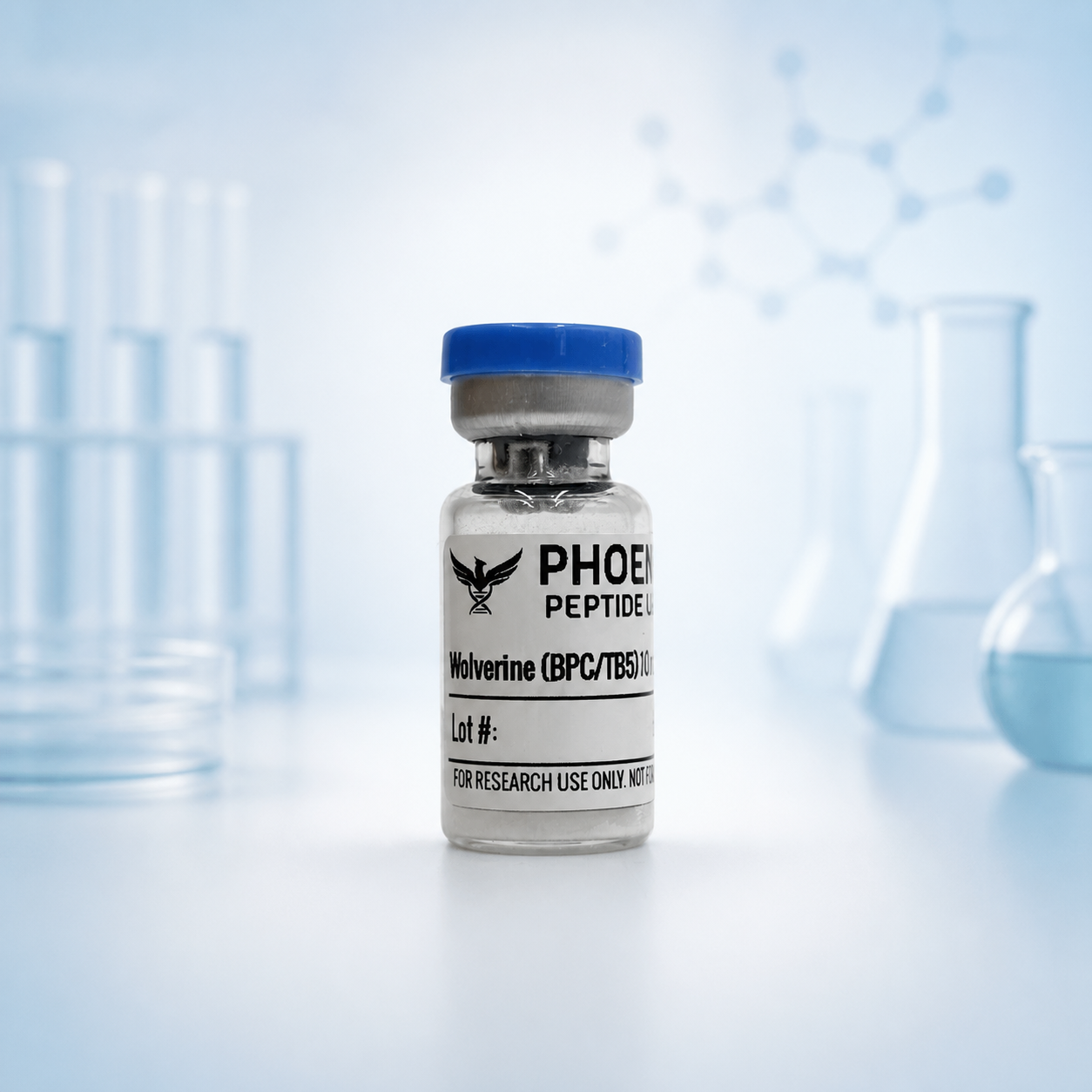
Description
The mechanistic rationale for this combination is among the most clearly articulated in peptide research — two distinct molecular mechanisms that operate in spatial and temporal parallel across all phases of soft tissue healing.
BPC-157 — Local Vascular Architecture and Structural Repair
BPC-157’s mechanism is comprehensively detailed in its dedicated product page. Within the specific context of this binary blend, its irreplaceable contributions are:
VEGFR2/Akt-eNOS Angiogenesis
- BPC-157 activates VEGF Receptor 2 (VEGFR2) on endothelial cells at and near the injury site → Akt phosphorylation → eNOS activation → nitric oxide production → vasodilation and de novo capillary sprouting
- This creates a vascularized tissue bed at the injury site — the essential prerequisite for all downstream cellular repair. Without new capillary networks, oxygen and nutrient delivery to the wound zone is insufficient to sustain the high metabolic demands of proliferating fibroblasts and synthesizing collagen
- BPC-157’s angiogenesis is injury-localized: it activates collateral vessel formation around occluded or damaged vessels, restoring perfusion to previously ischemic tissue — a property uniquely important for tendons, ligaments, and cartilage, which have naturally poor baseline vascularization
FAK-Paxillin Fibroblast Activation
- BPC-157 activates focal adhesion kinase (FAK) and paxillin in tendon fibroblasts — the signaling complex that anchors cells to the extracellular matrix and initiates the cellular motility machinery
- In Chang et al.’s seminal tendon outgrowth study, BPC-157 increased fibroblast migration speed up to 2.3-fold — a direct structural-level healing acceleration at the wound interface
Mesenchymal Stem Cell and Periosteal Cell Recruitment
- BPC-157 uniquely activates periosteal cells and recruits mesenchymal stem cells to damaged connective tissue interfaces, enabling the muscle-to-bone and tendon-to-bone reattachment that neither TB-500 nor any other peptide in this catalog specifically addresses
Nitric Oxide System Modulation
- BPC-157 maintains physiological balance in the nitric oxide system — stabilizing vascular tone, preventing ischemic vasoconstriction, and sustaining the vasodilatory environment necessary for robust nutrient delivery throughout the healing period
TB-500 — Systemic Cellular Mobilization and Anti-Fibrotic Remodeling
TB-500’s mechanism is comprehensively detailed in its dedicated section of the GHK-Cu/TB-500/BPC-157 product page. In this binary combination context, its unique contributions are:
G-Actin Sequestration — The Cellular Traffic Director
- TB-500 binds free G-actin (monomeric actin) in cells throughout the body — not just at the injury site — buffering the G-actin/F-actin equilibrium and thereby controlling the cytoskeletal dynamics that determine whether cells can change shape, migrate, divide, and adhere to new locations
- By maintaining a mobile, reorganizable cytoskeleton in repair cells, TB-500 enables the rapid, directional migration of fibroblasts, keratinocytes, satellite cells, and endothelial cells toward injury-generated chemotactic gradients
- This is TB-500’s systemic advantage over BPC-157’s more localized action: TB-500 circulates throughout the body and primes every potential repair cell for migration readiness — not just those near the injection or injury site
Endothelial Cell Migration — Complementary Angiogenesis Pathway
- While BPC-157 drives angiogenesis through VEGFR2 signaling on resident endothelial cells, TB-500 drives angiogenesis through a cell-trafficking mechanism — mobilizing circulating endothelial progenitors and promoting directed endothelial migration into the wound bed
- These are two independent and additive angiogenic pathways — BPC-157 provides the molecular signal; TB-500 provides the cellular workforce for vascular tube formation
Anti-Fibrotic Remodeling
- TB-500 reduces myofibroblast numbers at wound sites — myofibroblasts are the cells responsible for scar tissue contraction and fibrosis
- This anti-fibrotic activity guides matrix deposition toward organized, functional collagen rather than disorganized scar, preventing the strength-compromising tissue architecture that often limits return-to-function after musculoskeletal injury
- Critically, BPC-157 independently modulates MMP/TIMP balance for collagen turnover — the two peptides address the anti-fibrotic outcome through complementary matrix remodeling mechanisms
ILK-Akt Cell Survival
- TB-500 activates Integrin-Linked Kinase (ILK) → Akt signaling in cardiomyocytes and other cell types, reducing apoptosis in the ischemic wound environment
- This anti-apoptotic signaling protects repair cells that have migrated to the oxygen-depleted wound zone from dying before completing their repair function — a form of cellular persistence that is complementary to BPC-157’s oxygen delivery (through angiogenesis) at the same site
The Core Synergy — Local + Systemic, Structural + Cellular
The combination’s pharmacological logic rests on a fundamental division of labor:
Dimension | BPC-157 | TB-500 | Combined |
Primary mechanism | VEGFR2/eNOS angiogenesis; FAK-paxillin; structural repair | G-actin sequestration; cell migration; ILK-Akt | Vascular architecture + cellular workforce |
Spatial range of action | Primarily local / injury-site concentrated | Systemic — acts throughout the body | Local structural + systemic cellular coverage |
Angiogenesis pathway | VEGFR2 molecular signaling | Endothelial cell migration | Two independent, additive pro-angiogenic inputs |
Anti-fibrosis | MMP/TIMP collagen turnover regulation | Myofibroblast reduction | Dual anti-fibrotic mechanism |
Receptor target | VEGFR2, GHR, nitric oxide system | G-actin, ILK, integrins | Non-competing, no receptor overlap |
Cell types directly activated | Tendon fibroblasts, periosteal cells, MSCs | Fibroblasts, keratinocytes, endothelial cells, satellite cells | Comprehensive cell type coverage |
Structural specialty | Tendon-to-bone, muscle-to-bone reattachment | Organized collagen architecture; anti-scar | Full tissue architecture restoration |
A useful clinical analogy: BPC-157 builds the highway; TB-500 puts the cars on it. BPC-157 establishes new blood vessel networks and activates structural repair pathways; TB-500 ensures that a continuous flow of migratory repair cells — the workers that carry out the actual rebuilding — arrives at the construction site and operates efficiently.
TB-500 Metabolite Nuance
A 2024 study noted that TB-500 (Ac-LKKTETQ) itself may not directly increase wound-healing activity in isolation — rather, its metabolite Ac-LKKTE was identified as the active wound-healing agent, suggesting TB-500 acts as a prodrug-like precursor that is metabolized in vivo to its active form. This does not diminish its pharmacological value but is an important mechanistic nuance acknowledged in the current literature.
Reviews
There are no reviews yet.