
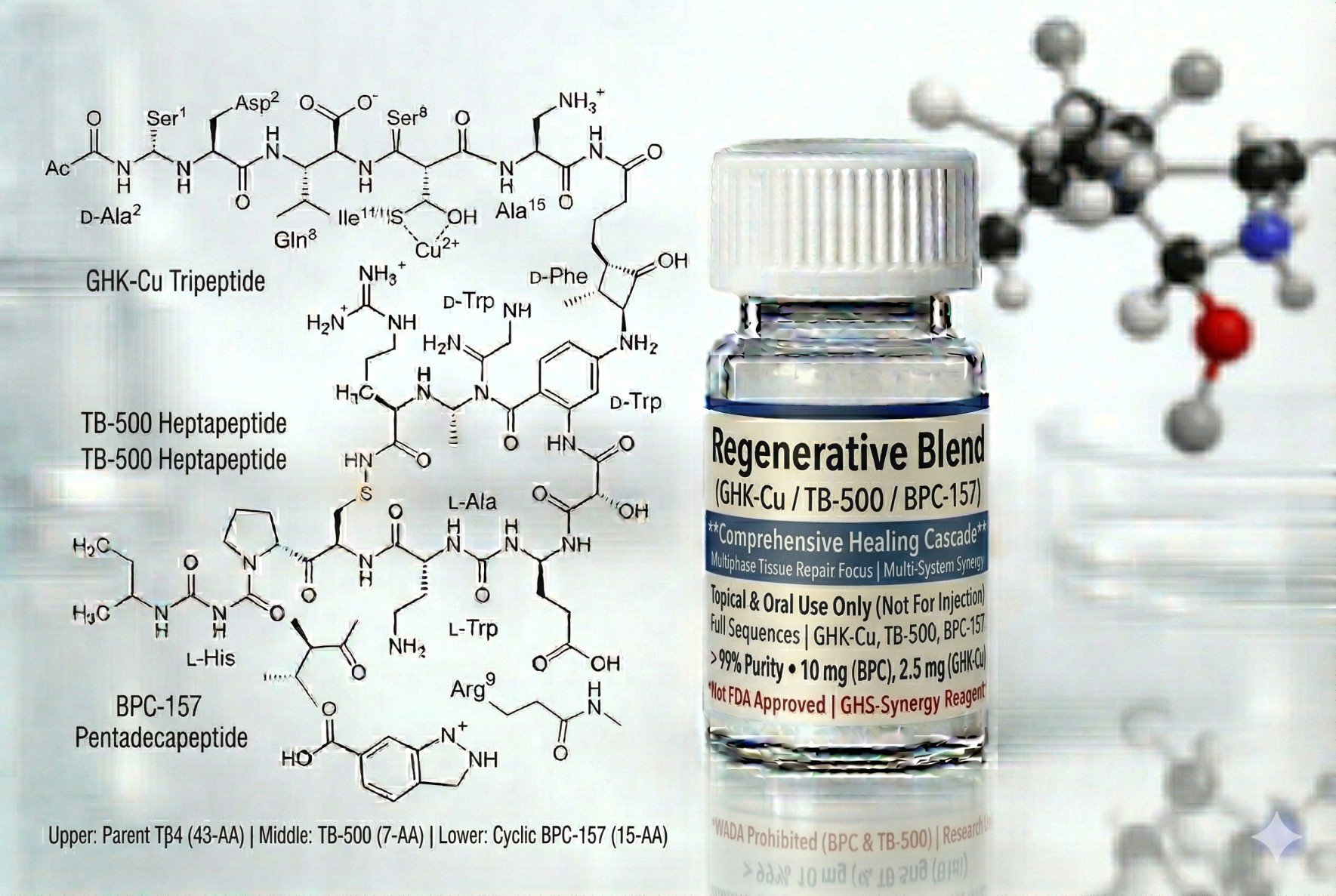
Description
Each peptide in this blend targets a distinct biological pathway, and the three pathways operate in a coordinated, temporally overlapping sequence that provides comprehensive coverage of the healing cascade.
GHK-Cu — Gene Expression Reset, ECM Remodeling, and Angiogenesis
GHK-Cu operates through three primary mechanisms: copper-mediated enzymatic activation, extracellular matrix (ECM) remodeling, and broad-spectrum gene expression modulation:
Copper Chaperone and Enzymatic Activation
- GHK’s histidine residue chelates Cu²⁺ with high affinity, serving as a copper chaperone that delivers bioavailable copper to copper-dependent enzymes at the site of injury
- Key copper-dependent enzymes activated include: lysyl oxidase (crosslinks collagen and elastin fibers for tensile strength), superoxide dismutase (Cu/Zn-SOD) (neutralizes superoxide radicals), and ceruloplasmin (ferroxidase involved in iron metabolism and antioxidant defense)
- Copper delivery to cytochrome c oxidase (Complex IV) of the mitochondrial ETC also supports cellular bioenergetics in injured tissues
ECM Remodeling — Collagen, Elastin, and Proteoglycans
- GHK-Cu is among the most potent known stimulators of fibroblast collagen synthesis: in vitro, it increases Type I and III collagen mRNA expression; in vivo rat wound chamber studies demonstrated a concentration-dependent increase in collagen content that was twice that of non-collagen protein stimulation
- GHK-Cu uniquely stimulates both synthesis and breakdown of collagen simultaneously through balanced MMP (matrix metalloproteinase) and TIMP (tissue inhibitor of MMP) regulation — accelerating turnover and preventing excessive scar/fibrosis while building new organized matrix
- Additional ECM targets: elastin, decorin (a small leucine-rich proteoglycan that organizes collagen fibrils), chondroitin sulfate, dermatan sulfate, and glycosaminoglycans (including hyaluronic acid) — a comprehensive remodeling profile
Angiogenesis and Nerve Outgrowth
- GHK-Cu activates VEGF (Vascular Endothelial Growth Factor) and supports endothelial cell proliferation, migration, and tube formation — stimulating formation of new capillary networks essential for delivering oxygen and nutrients to healing tissue
- Nerve growth factor (NGF)-like effects: GHK-Cu promotes neuronal outgrowth and may support peripheral nerve regeneration at injury sites
Gene Expression Remodeling — The Genomic Dimension
- The most expansive — and most scientifically striking — dimension of GHK-Cu biology comes from genomic profiling using the Broad Institute’s Connectivity Map (CMap): GHK was found to modulate expression of 4,047 human genes, with a pattern that globally shifts cells toward younger, less-diseased transcriptional states
- Key gene categories upregulated: DNA repair genes (47 of 55 DNA repair genes tested), anti-cancer tumor suppressor genes (caspase and apoptotic regulators), stem cell function genes (57 relevant genes upregulated), and anti-inflammatory regulators (NF-κB suppression, TNF-α reduction)
- Key gene categories downregulated: pro-inflammatory cytokines, fibrin formation genes, and genes associated with tissue destruction — a complementary profile that removes barriers to healing while activating repair
- GHK has been proposed as a potential intervention in COPD, metastatic cancer gene reprogramming, Alzheimer’s disease, and acute lung injury based on Connectivity Map analysis showing reversal of disease-associated gene expression patterns
TB-500 — Actin Regulation, Cell Migration, and Anti-Fibrosis
TB-500 operates through a fundamentally different mechanism from both GHK-Cu and BPC-157 — its biology is rooted in cytoskeletal regulation:
Actin Sequestration and Cytoskeletal Dynamics
- Thymosin Beta-4 (and its TB-500 fragment) is the primary G-actin (monomeric actin) sequestering protein in mammalian cells — it binds free G-actin monomers and buffers the cellular pool available for F-actin (filamentous actin) polymerization
- By modulating the G-actin/F-actin equilibrium, TB-500 controls cytoskeletal dynamics — the fundamental machinery that drives cell shape changes, migration, and division
- In injured tissue, TB-500’s actin regulation enables rapid migration of repair cells (fibroblasts, keratinocytes, endothelial cells, satellite cells) from the wound periphery into the injury zone — a rate-limiting step in tissue repair
Cellular Migration and Wound Closure
- TB-500 increases expression of matrix metalloproteinases (MMPs) at the wound edge, degrading ECM to clear a path for migrating cells while simultaneously promoting synthesis of new matrix proteins in the wound bed
- Stimulates proliferation and migration of keratinocytes (re-epithelialization), endothelial cells (angiogenesis), and fibroblasts (collagen deposition) — addressing all three major cell types required for wound closure
- TB-500’s LKKTETQ motif directly promotes endothelial cell and keratinocyte migration through binding to actin-associated surface receptors and integrin signaling
Anti-Inflammatory and Anti-Fibrotic Effects
- TB-500 suppresses TNF-α, IL-1β, and NF-κB — major orchestrators of the destructive inflammatory phase that, when prolonged, causes fibrosis and impaired healing
- A critical and underappreciated property: TB-500 prevents excessive fibrosis during wound healing, guiding matrix deposition toward organized collagen networks rather than disorganized scar tissue — explaining its interest in cardiac fibrosis, hepatic fibrosis, and chronic wound research
- In diabetic wound models and aged animal models, TB-500 restored healing responses that were markedly impaired — suggesting it specifically rescues the cellular migration deficit underlying chronic non-healing wounds
Angiogenesis (Complementary Pathway)
- TB-500 promotes angiogenesis through endothelial cell mobilization and migration — a cell-trafficking mechanism complementary to GHK-Cu’s VEGF transcriptional pathway and BPC-157’s VEGFR2 signaling pathway
BPC-157 — Structural Repair, VEGF/Nitric Oxide Vascular Restoration, and Cytoprotection
BPC-157’s mechanism is detailed extensively in its dedicated product page. Within the context of this blend, its unique and non-redundant contributions are:
- Structural tissue reattachment: BPC-157 specifically activates periosteal cells and recruits mesenchymal stem cells to damaged connective tissue interfaces — enabling muscle-to-bone and tendon-to-bone reconnection that neither GHK-Cu nor TB-500 addresses
- VEGFR2/Akt-eNOS angiogenesis: BPC-157’s activation of VEGFR2 → Akt → eNOS is a molecularly distinct angiogenic pathway from GHK-Cu’s VEGF transcription and TB-500’s endothelial cell migration — the three pathways synergistically deliver a comprehensive vascular restoration signal
- FAK-paxillin cell migration: BPC-157 activates focal adhesion kinase and paxillin signaling in tendon fibroblasts, complementing TB-500’s actin-based migration mechanism
- Gastrointestinal and systemic cytoprotection: BPC-157’s gastric origin and mucosal protective properties provide a systemic protective scaffold for the liver, kidney, and intestinal lining from oxidative and ischemic stress
- Neurotransmitter modulation: BPC-157’s serotonergic and dopaminergic effects add a neurological repair dimension not present in the other two components
Phase-by-Phase Synergy of the Blend
The three peptides operate in a coordinated temporal sequence that covers all four phases of wound healing:
Healing Phase | GHK-Cu | TB-500 | BPC-157 |
Hemostasis / Early Inflammation | Gene reprogramming; NF-κB/TNF-α suppression; antioxidant enzyme activation | Acute TNF-α, IL-1β suppression; reduces neutrophil infiltration | Cytoprotection; nitric oxide balance; early vascular stability |
Proliferative / Cellular Migration | VEGF upregulation; fibroblast proliferation; collagen synthesis begins | Cell migration via actin regulation; endothelial/keratinocyte recruitment | Mesenchymal stem cell recruitment; periosteal activation; FAK-paxillin migration |
Angiogenesis | VEGF transcription; capillary formation | Endothelial migration and tube formation | VEGFR2/eNOS signaling; collateral vessel formation |
Remodeling / Resolution | Balanced MMP/TIMP regulation; collagen crosslinking via lysyl oxidase; elastin synthesis; anti-fibrotic | Anti-fibrotic; organized collagen architecture guidance | Tendon/ligament maturation; nerve and vascular remodeling |
Reviews
There are no reviews yet.