
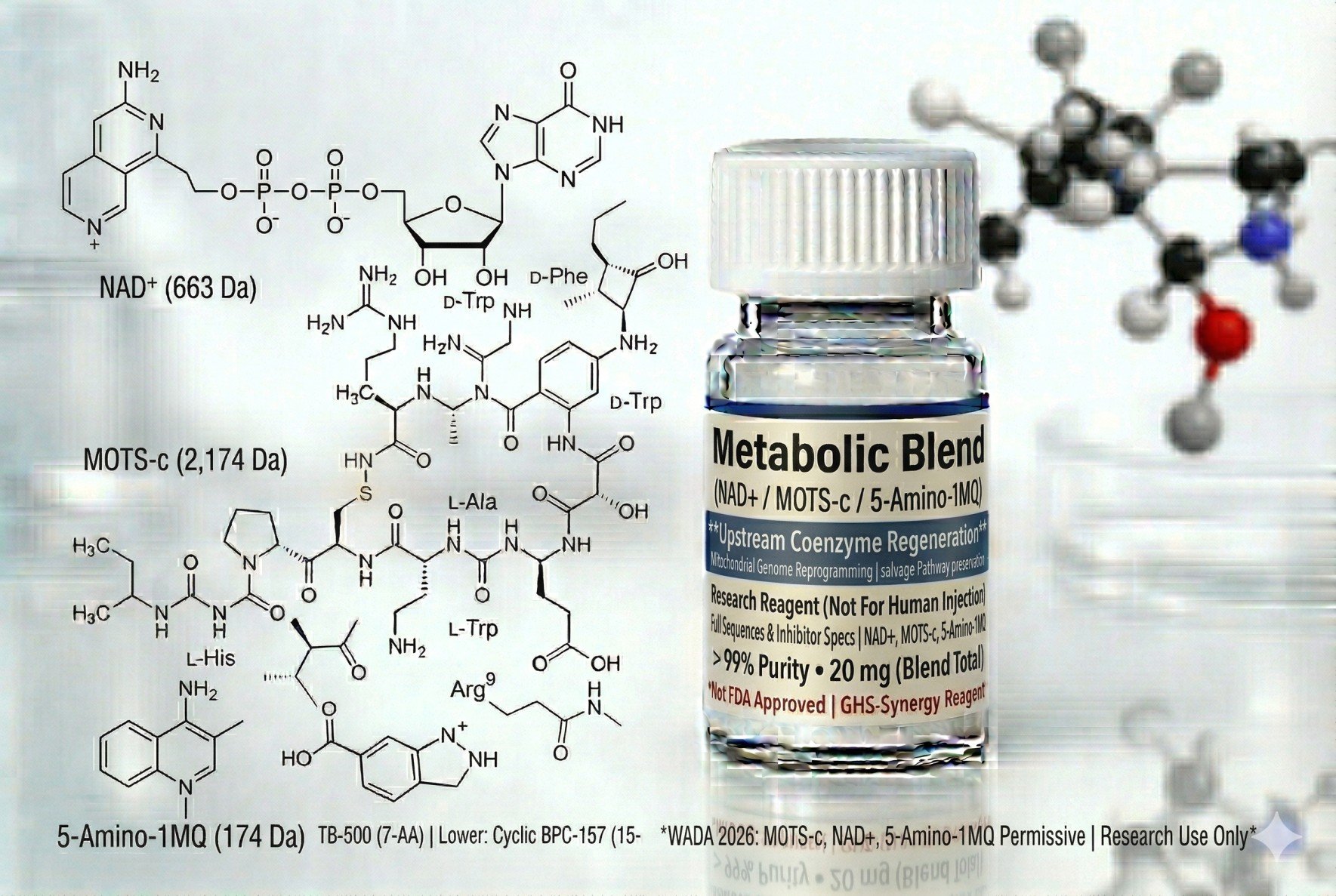
Description
NAD+ — Coenzyme Substrate Replenishment Across Four Critical Enzymatic Systems
NAD+ functions as the central metabolic currency connecting cellular energy production, genome maintenance, epigenetic regulation, and stress response:
Mitochondrial Energy Production
- In its reduced form NADH, NAD+ carries high-energy electrons from the citric acid cycle to Complex I of the electron transport chain — the first step of oxidative phosphorylation that generates the proton gradient driving ATP synthase
- Complex I oxidizes NADH back to NAD+, regenerating the coenzyme for further metabolic reactions; when NAD+ is depleted, this cycle stalls, impairing cellular ATP production at its most fundamental level
- The NADH/NAD+ ratio is a master sensor of cellular energy status — a high ratio signals energy excess; a low ratio signals energetic stress and activates catabolic programs
Sirtuin Activation — Epigenetic Regulation and Mitochondrial Biogenesis
- SIRT1–7 are NAD+-dependent protein deacetylases that require NAD+ as a co-substrate (consumed in each reaction, not catalytically recycled) — meaning sirtuin activity is directly limited by NAD+ availability
- SIRT1: Deacetylates and activates PGC-1α, the master regulator of mitochondrial biogenesis, fatty acid oxidation, and antioxidant defense; also activates FOXO transcription factors (stress resistance) and suppresses NF-κB (inflammation)
- SIRT3: Localizes to mitochondria; deacetylates and activates Complex I, isocitrate dehydrogenase, and MnSOD (mitochondrial antioxidant defense); directly links NAD+ availability to mitochondrial ROS control
- SIRT6: Deacetylates histones at DNA damage sites, activates DNA repair machinery, and regulates telomere maintenance
PARP1/2 — DNA Damage Sensing and Repair
- PARP1 consumes massive quantities of NAD+ (up to 100 molecules per activation event) in response to DNA strand breaks, adding poly-ADP-ribose chains to histones and other proteins to signal and coordinate DNA repair
- Chronic DNA damage with aging triggers sustained PARP1 activation — creating an autocatalytic cycle where DNA damage depletes NAD+, impaired sirtuin activity reduces DNA repair, which generates more DNA damage, further depleting NAD+
- Restoring NAD+ breaks this cycle by providing substrate for both PARP (repair) and sirtuins (prevention)
CD38 — Calcium Signaling and Age-Related NAD+ Consumption
- CD38 is an ectoenzyme that increases substantially with age and inflammation; it hydrolyzes NAD+ to generate cyclic ADP-ribose (cADPR), a calcium-mobilizing messenger
- Chronic CD38 upregulation by senescent cells and macrophages contributes meaningfully to age-related NAD+ decline — an important reason why simply supplementing NAD+ precursors may be insufficient in inflamed aging tissue
- Direct NAD+ (100 mg injectable) provides an acute surge in intracellular NAD+ availability that can overcome CD38-mediated consumption and directly replete sirtuin-accessible pools
NAD+ Biosynthesis Pathways — Why Precursor Form Matters
- NAD+ itself cannot efficiently enter most cells directly due to its charged phosphate groups and large molecular size
- Oral/injectable precursors (NMN, NR) enter cells through dedicated transporters and are phosphorylated intracellularly to NAD+ — a more biologically efficient route for sustained tissue replenishment
- Injectable NAD+ produces rapid, large-amplitude plasma spikes but whether this translates to intracellular NAD+ elevation in target tissues (brain, muscle) or is primarily metabolized extracellularly remains debated among researchers
- 5-Amino-1MQ (see below) addresses this limitation by preserving endogenous NAD+ production through NNMT inhibition — a complementary strategy that works from the biosynthetic side
MOTS-c — Mitochondrial-Nuclear Retrograde Signaling and Exercise Mimicry
MOTS-c operates through a mechanism unlike any other metabolic agent — it is a hormonal signal encoded by mitochondrial DNA that travels to the nucleus to reprogram gene expression in response to metabolic stress:
Folate-AICAR-AMPK Pathway — The Primary Metabolic Axis
- MOTS-c’s primary molecular mechanism begins in the folate cycle: MOTS-c inhibits key enzymes of the folate/one-carbon metabolic pathway, causing accumulation of 5-aminoimidazole-4-carboxamide ribonucleotide (AICAR) — a purine synthesis intermediate
- Accumulated AICAR is a well-validated endogenous activator of AMP-activated protein kinase (AMPK) — the master cellular energy sensor that detects low ATP/AMP ratios and activates catabolic programs to restore energy balance
- AMPK activation by MOTS-c produces a coordinated metabolic shift: increased glucose uptake (GLUT4 translocation), enhanced fatty acid oxidation (ACC phosphorylation → reduced malonyl-CoA → increased CPT1 activity → mitochondrial fat import), upregulated mitochondrial biogenesis (via PGC-1α), and reduced anabolic energy consumption
- Critically, MOTS-c achieves this AMPK activation without energy depletion — it mimics the hormetic stress signal of exercise without the metabolic cost of exercise itself
Nuclear Translocation — Stress Adaptation Gene Expression
- Under metabolic stress or exercise, MOTS-c translocates from mitochondria to the cell nucleus where it directly modulates transcription of genes with Antioxidant Response Elements (AREs)
- Nuclear MOTS-c activates the Nrf2/ARE pathway — upregulating genes for glutathione synthesis, peroxiredoxins, thioredoxin reductase, and heme oxygenase-1 — a comprehensive antioxidant program
- MOTS-c also suppresses methionine metabolism — a key pathway in cellular aging; in rodents, methionine restriction extends lifespan by up to 45%
NAD+ Elevation — The Convergence Point
- MOTS-c elevates intracellular NAD+ through AMPK-mediated upregulation of NAMPT (the rate-limiting enzyme in the NAD+ salvage pathway)
- SIRT1 mediates MOTS-c’s glycolytic actions downstream — meaning MOTS-c’s benefits are partly NAD+-dependent, and the two compounds in this blend are mutually reinforcing: NAD+ provides substrate; MOTS-c upregulates the enzymes that use it and produce more of it
Exercise Physiology — Endocrine Roles
- MOTS-c is released from skeletal muscle mitochondria during exercise and acts as an exercise-induced mitohormone — it signals throughout the body to coordinate metabolic adaptations to physical stress
- Exogenous MOTS-c in mice increased treadmill running duration in young mice by ~1.5–2x, middle-aged mice by a comparable magnitude, and old mice by 2-fold — with old mice on MOTS-c entering the highest speed stage (impossible without treatment)
- The mechanism involves both improved skeletal muscle insulin sensitivity (GLUT4/Akt pathway) and enhanced mitochondrial efficiency in responding to exercise-induced metabolic stress
5-Amino-1MQ — NNMT Inhibition and Adipocyte Metabolic Reprogramming
5-Amino-1MQ targets Nicotinamide N-Methyltransferase (NNMT) — a cytosolic enzyme highly expressed in white adipose tissue that catalyzes the methylation of nicotinamide (vitamin B3) using S-adenosylmethionine (SAM) as the methyl donor:
The NNMT Problem — NAD+ Drain in White Adipose Tissue
- NNMT methylates nicotinamide to 1-methylnicotinamide (MNA), directing it away from the NAD+ salvage pathway (where NAMPT would normally convert it to NMN → NAD+)
- High NNMT activity in obese and aging white adipose tissue simultaneously: depletes the NAD+ precursor pool (less nicotinamide available for NAMPT), consumes SAM (reducing methylation capacity for epigenetic regulation), and shifts adipocytes toward a storage-dominant metabolic phenotype
- NNMT expression is elevated in obesity, type 2 diabetes, and aging — creating a self-reinforcing cycle where metabolic dysfunction upregulates NNMT, which further impairs NAD+-dependent metabolism
5-Amino-1MQ Mechanism — Plugging the NAD+ Drain
- 5-Amino-1MQ is a methylquinolinium analog that competitively inhibits NNMT with high selectivity — it does not inhibit NAMPT, related methyltransferases, or NAD+ salvage pathway enzymes at relevant concentrations
- High membrane permeability (validated in parallel artificial membrane permeability [PAMPA] and Caco-2 cell assays) allows 5-Amino-1MQ to reach intracellular NNMT in adipocytes
- NNMT inhibition redirects nicotinamide back into the NAMPT-mediated NAD+ salvage pathway → elevated intracellular NAD+ specifically in adipocytes
Downstream Metabolic Reprogramming in Adipocytes
- Elevated adipocyte NAD+ activates SIRT1 → upregulates PGC-1α → drives mitochondrial biogenesis and fatty acid oxidation programs within fat cells
- Enhanced AMPK signaling (partly NAD+/SIRT1-dependent) promotes catabolic pathways — the fat cell shifts from a storage-dominant to an energy-expenditure-dominant metabolic profile
- The most consistent subjective signal in user reports and mechanistically predicted sequence: energy and endurance improve first (mitochondrial biogenesis is upstream), followed by body composition changes (fat oxidation is downstream)
The Complementarity with NAD+ and MOTS-c
- NAD+ injectable: floods the system with substrate — broad-spectrum coenzyme replenishment across all tissues
- MOTS-c: reprograms the metabolic software — AMPK/PGC-1α activation, nuclear stress adaptation gene expression, improved insulin sensitivity in muscle
- 5-Amino-1MQ: stops the leak — prevents NNMT from siphoning the NAD+ precursor pool in the specific tissue (white adipose tissue) where NAD+ depletion has the greatest impact on body composition
Convergence Point: The NAD+/AMPK/SIRT1/PGC-1α Axis
All three components of this blend ultimately converge on the same downstream signaling network:
Pathway Node | NAD+ | MOTS-c | 5-Amino-1MQ |
NAD+ availability | Direct replenishment | NAMPT upregulation via AMPK | NNMT inhibition → precursor preservation |
SIRT1 activation | Substrate provision | Downstream of AMPK/PGC-1α | Via elevated adipocyte NAD+ |
AMPK activation | Indirect (via SIRT1/LKB1) | Direct (Folate-AICAR pathway) | Indirect (via NAD+/SIRT1) |
PGC-1α / mitochondrial biogenesis | Via SIRT1 deacetylation | Direct downstream target | Via SIRT1 in adipocytes |
Primary tissue target | Systemic / all tissues | Skeletal muscle / systemic | White adipose tissue |
Reviews
There are no reviews yet.